
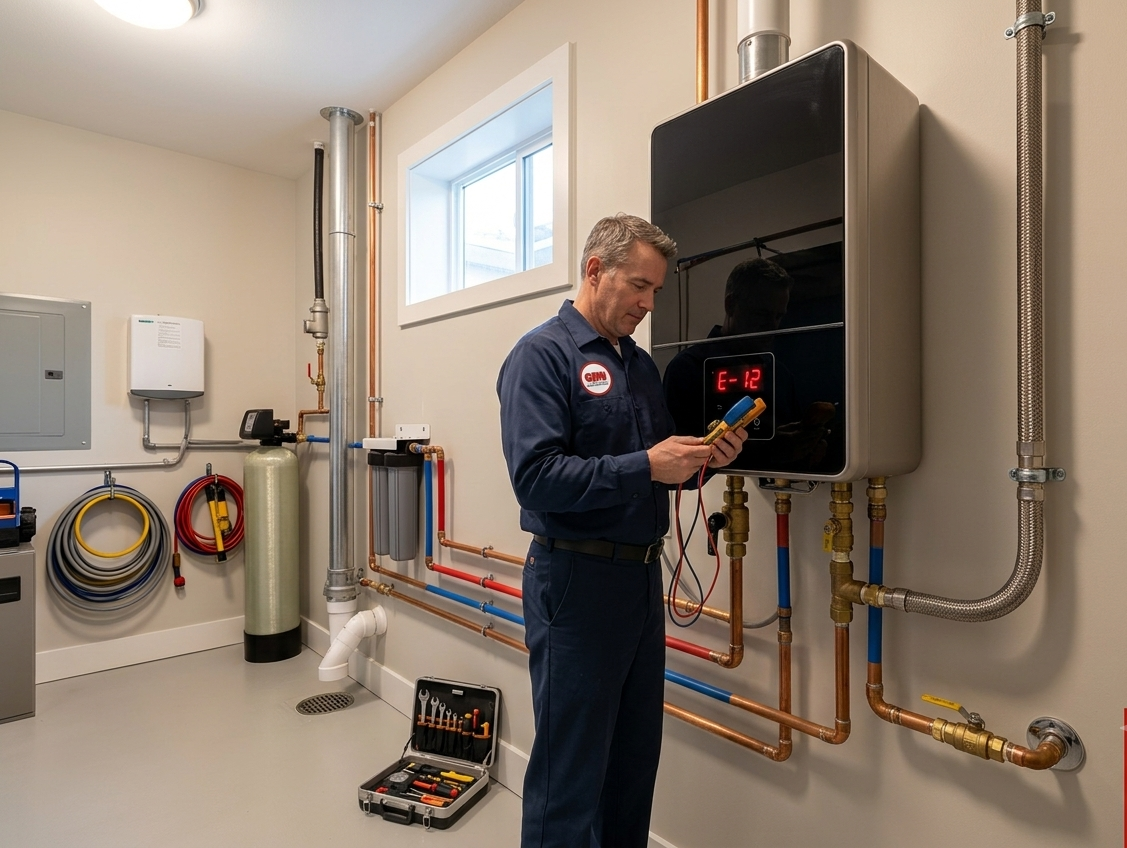
A tankless water heater displaying an error code is telling you exactly what’s wrong — the two-digit number on the remote or unit display corresponds to a specific fault, from a blocked vent to a failed ignition to mineral buildup on the heat exchanger. Some codes (like a closed water valve) you can fix yourself in minutes. Others (gas supply, ignition, or exhaust faults) require a licensed HVAC Contractor Surrey, because they involve combustion safety. This guide breaks down what each common code means and when Surrey homeowners should stop troubleshooting and call for service.
Why Tankless Water Heaters Show Error Codes in the First Place
Unlike a conventional tank water heater, a tankless (on-demand) unit runs a full diagnostic check every time it fires up — sensing water flow, gas pressure, ignition, venting, and exhaust temperature in real time. When one of those readings falls outside a safe range, the unit’s control board shuts down combustion and displays a code rather than letting the system run unsafely. This is a built-in safety feature, not a design flaw, and it’s one of the reasons tankless systems have a strong safety record when installed and maintained correctly.
Surrey’s water hardness and our wet coastal climate both play a role here. Mineral scale from moderately hard water is one of the most common causes of flow-sensor and heat-exchanger errors in tankless units that haven’t been descaled in a year or more, and improperly sealed vent terminations can let wind-driven rain trigger exhaust-related faults, especially on units installed on north- or west-facing exterior walls.
Common Tankless Water Heater Error Codes and What They Mean
Exact code numbers vary slightly by manufacturer (Rinnai, Navien, Noritz, and Rheem all use their own numbering), but most codes fall into the same handful of categories.
Ignition and Flame Failure Codes
Codes in this group (often labelled 11, 12, or “LC/PF” on newer displays) mean the unit tried to ignite but didn’t detect a stable flame, or the flame dropped out mid-cycle. Common causes include a closed or partially closed gas valve, low gas supply pressure, a dirty flame rod, or a failed igniter.
What you can check: Confirm the gas shutoff valve to the unit is fully open, and that no other gas appliance is running at the same time and starving the system of pressure.
When to call a technician: If the valve is open and the code returns, this is a combustion-safety issue. Do not attempt to clean or adjust ignition components yourself.
Water Flow and Sensor Codes
These typically appear when the unit isn’t detecting enough water flow to activate, or when a flow sensor is fouled with sediment. It’s often the first sign of scale buildup inside the heat exchanger.
What you can check: Make sure the hot water valve at the fixture is fully open and no inline filter or aerator is clogged.
When to call a technician: If flow-related codes recur across multiple fixtures, the unit likely needs a professional descaling flush — a routine maintenance service that also extends the unit’s lifespan.
Exhaust, Venting, and Blockage Codes
These codes point to a restricted or improperly sealed vent, a blocked intake, or (in colder months) ice or debris obstructing the outdoor termination.
What you can check: Visually inspect the exterior vent cap for leaves, snow, or a bird’s nest. Never insert anything into the vent yourself.
When to call a technician: Any exhaust-related code should be treated as urgent. Improper venting can allow carbon monoxide to backdraft into the home — this is not a DIY fix under any circumstance.
Overheat and High-Limit Codes
These indicate the unit detected water or exhaust temperatures above its safe operating limit, often due to scale insulation on the heat exchanger or a failed temperature sensor.
What you can check: Nothing safely — this code means the unit has already shut itself down as a protective measure.
When to call a technician: Immediately. Continued attempts to restart the unit without diagnosing the cause can shorten the heat exchanger’s life significantly.
Freeze Protection Codes
Common on units installed in unheated garages or exterior walls during a cold snap. The unit’s internal freeze-protection system has activated, or in more serious cases, a component has already frozen.
What you can check: Confirm the unit’s power supply hasn’t been interrupted — freeze protection only works while the unit is powered.
When to call a technician: If a freeze code appears alongside visible water at the unit, shut off the water supply and call for emergency service before pipes or the heat exchanger sustain damage.
When It’s Safe to Reset — and When It Isn’t
Most manufacturers allow one reset attempt (usually by pressing and holding a reset button, or powering the unit off and back on) after addressing an obvious cause like a closed valve. If the same code returns after one reset, stop. Repeated resets on a gas-fired appliance without resolving the underlying fault can mask a developing safety issue rather than fix it — this is one of the most common mistakes we see when we’re called out to a “mystery” tankless failure that homeowners had been resetting for weeks.
As a general rule: flow and sensor codes are usually maintenance issues, while ignition, exhaust, and overheat codes are safety issues. When in doubt, treat it as the latter.
Why Professional Diagnosis Matters for Tankless Systems
Tankless water heaters are more electronically sophisticated than tank models, and misdiagnosing a code — or working on a gas or venting component without the right training — can void your manufacturer warranty and, more importantly, create a genuine safety hazard. A licensed HVAC technician Surrey uses the unit’s diagnostic history (most modern units log the last several error events) to identify whether a code is a one-off event or a pattern pointing to a bigger repair. Our technicians are trained on the major tankless brands installed across Surrey, Langley, and New Westminster homes, and every tankless water heater repair Surrey call includes a full combustion and venting safety check, not just a code reset.
Preventing Error Codes Before They Start
Annual professional maintenance is the single biggest factor in preventing tankless error codes, particularly in a moderately hard-water region like Surrey. A yearly descaling flush, filter cleaning, and venting inspection catches the early-stage scale buildup and sensor drift that eventually trigger flow, overheat, and ignition codes — often before you ever see an error message.
If your tankless unit is more than five years old and has never been professionally descaled, that’s the most likely explanation for recurring codes, and it’s a service that typically pays for itself in extended equipment life and lower gas usage.
Get Your Tankless Water Heater Diagnosed by a Surrey Technician
If your tankless water heater is flashing a code that won’t clear, don’t keep resetting it and hoping. Guru Service Group’s licensed technicians diagnose and repair all major tankless brands across Surrey, Langley, and New Westminster, with same-day service available for urgent no-hot-water and safety-related calls. Book an appointment online or call us today to restore safe, reliable operation.
Frequently Asked Questions
Can I reset my tankless water heater myself?
Yes, most units allow one manual reset after you've checked and corrected an obvious cause, like a closed water or gas valve. If the same code reappears after one reset, stop and call a licensed technician instead of resetting repeatedly.
How much does tankless water heater error code repair cost in Surrey?
Cost depends on the cause — a simple flow-sensor cleaning or valve adjustment is far less expensive than replacing an ignition control board or heat exchanger. A technician can give you an accurate quote after diagnosing the specific code.
How often should a tankless water heater be serviced to avoid error codes?
Most manufacturers, and our technicians, recommend annual descaling and inspection, especially in areas with moderately hard water like Surrey, where mineral scale is the leading cause of flow and overheat codes.
Is it dangerous to keep using a tankless water heater that's showing an error code?
It can be, particularly for ignition, exhaust, or overheat codes, which are tied to combustion safety. These should be diagnosed by a licensed technician before the unit is used again, rather than repeatedly reset.