
For a commercial property, an HVAC system is much more than a heating and cooling appliance. It affects indoor comfort, air quality, equipment performance, energy use, and the day-to-day operation of the building. When heating or cooling equipment fails unexpectedly, the resulting disruption can affect employees, customers, tenants, and business operations.
This is why many Surrey businesses consider a planned commercial HVAC maintenance contract rather than relying entirely on reactive repairs. A structured maintenance agreement can establish a regular inspection and servicing schedule, identify developing problems earlier, and provide a clearer approach to maintaining critical HVAC equipment throughout the year.
What Is a Commercial HVAC Maintenance Contract?
A commercial HVAC maintenance contract is an ongoing service arrangement between a business and an HVAC provider. Instead of waiting for equipment to malfunction, the system is inspected and maintained according to an agreed schedule.
The exact services vary depending on the building, equipment, usage, and contract terms. A maintenance plan may cover heating systems, air conditioning equipment, rooftop units, ventilation equipment, heat pumps, air handlers, controls, and other components associated with the building’s HVAC system.
The main objective is preventive maintenance: identifying conditions that could develop into larger performance or reliability problems before they result in an unexpected breakdown.
Why Preventive Maintenance Matters for Commercial Buildings
Commercial HVAC systems often operate for long periods and may experience significantly more usage than residential equipment. Even a relatively minor issue can become more serious when equipment continues operating under abnormal conditions.
For example, restricted airflow, dirty filters, loose electrical connections, worn components, or poor drainage can affect system performance. If these issues remain unnoticed, the equipment may experience additional strain.
Regular maintenance provides an opportunity to inspect these conditions and address appropriate issues before they become larger problems.
For businesses considering an HVAC Contractor Surrey, preventive maintenance should be viewed as part of a broader equipment-management strategy rather than simply another service appointment.
What Is Usually Included in a Commercial HVAC Maintenance Contract?
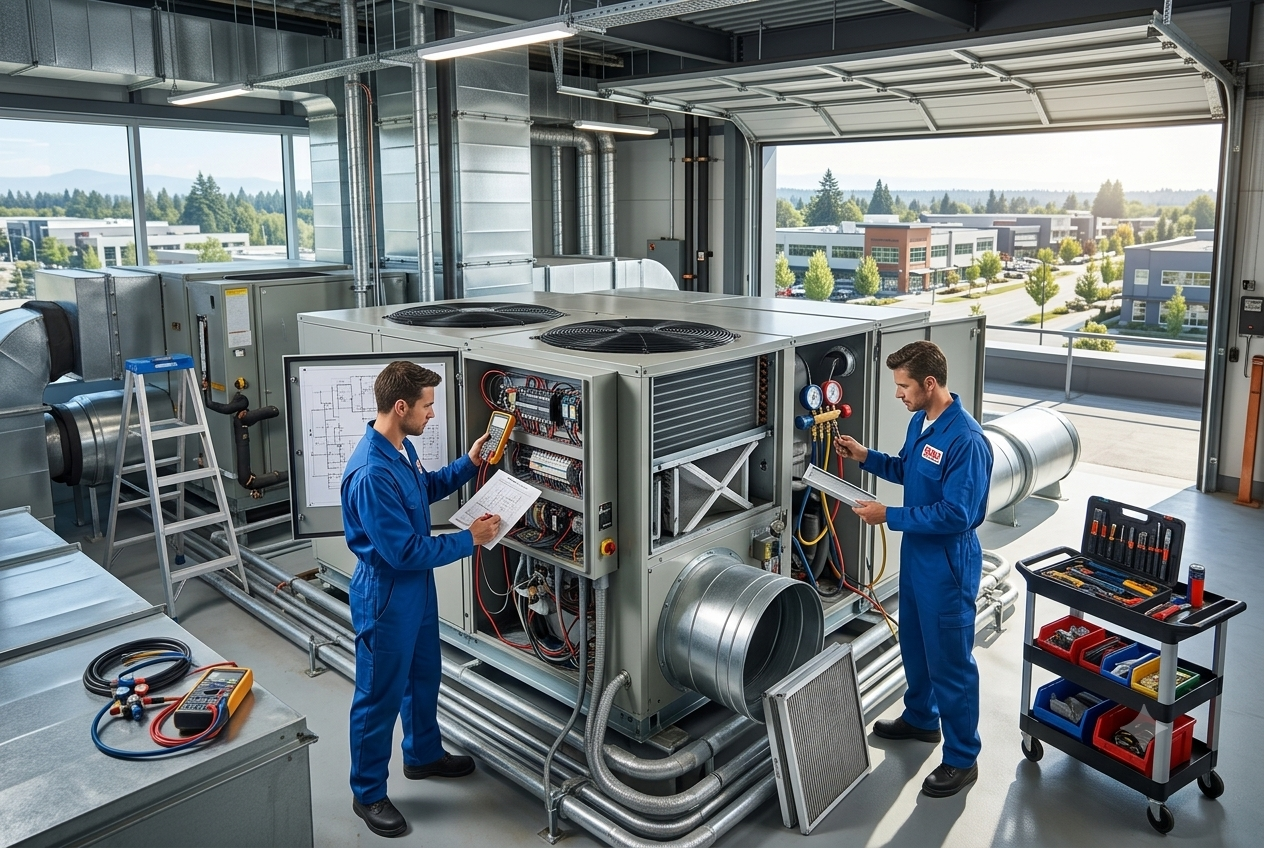
There is no universal checklist for every commercial building. A good maintenance plan should be based on the property’s equipment and operational requirements.
Depending on the contract, services may include:
- Equipment inspections
- Filter inspection and replacement
- Electrical connection checks
- Thermostat and control checks
- Airflow assessment
- Refrigeration system inspection
- Drain and condensate checks
- Coil inspection and cleaning
- Fan and blower inspection
- Belt and component checks
- Safety control inspection
- Performance testing
- Identification of unusual sounds or operating conditions
- Maintenance documentation
The exact scope should be clearly established before the contract begins.
Why HVAC Inspections Should Be Scheduled Throughout the Year
Commercial HVAC demand changes with the seasons. Heating systems may operate heavily during colder periods, while cooling equipment becomes increasingly important during warmer weather.
Seasonal inspections can help businesses identify potential problems before equipment enters a period of higher demand.
For example, inspecting cooling equipment before the summer operating season may provide an opportunity to identify airflow restrictions, refrigerant-related issues, electrical problems, or drainage concerns before cooling demand increases.
Likewise, heating equipment can be evaluated before sustained cold-weather operation.
A scheduled approach is generally more predictable than discovering a problem only after the building becomes uncomfortable.
How Maintenance Can Help Reduce Unexpected HVAC Repairs
Preventive maintenance does not guarantee that equipment will never fail. Mechanical and electrical components can still experience unexpected problems.
However, routine inspections can help identify signs of deterioration before a component causes a complete system failure.
An experienced HVAC Repair Surrey provider can evaluate unusual noises, inconsistent temperatures, reduced airflow, frequent cycling, unusual operating behaviour, and other warning signs during scheduled service.
Addressing appropriate issues earlier may reduce the likelihood of a minor problem developing into a more disruptive equipment failure.
What About Commercial HVAC Airflow?
Airflow is a critical part of HVAC performance. A system can have functioning heating or cooling components and still provide poor comfort if air is not moving properly through the building.
Maintenance inspections may evaluate filters, fans, blowers, duct-related issues, vents, dampers, and other components that influence airflow.
Poor airflow can contribute to uneven temperatures and may cause equipment to work harder than necessary.
For commercial properties with multiple zones, airflow and control issues can be particularly important because one area may experience comfort problems while another remains adequately conditioned.
Why Filters and Coils Matter
Filters and coils are often overlooked because they are not always visible to building occupants.
A restricted or heavily loaded filter can affect airflow, while dirty coils can interfere with heat transfer and overall system performance.
Maintenance requirements depend on equipment type, building conditions, operating hours, indoor air conditions, and manufacturer recommendations.
A commercial maintenance plan should therefore establish appropriate inspection intervals rather than assuming every building requires the same schedule.
How Maintenance Supports Energy Efficiency
HVAC equipment that is operating under poor conditions may consume more energy than necessary.
Restricted airflow, dirty components, inefficient operation, control problems, and equipment deterioration can all influence system performance.
Regular maintenance provides an opportunity to identify conditions that may be affecting efficiency. While maintenance alone cannot eliminate high energy consumption, keeping equipment properly serviced can support more consistent operation.
Businesses should also consider whether their controls, schedules, zoning, and equipment operation match the actual needs of the building.
Commercial HVAC Maintenance and Indoor Comfort
Indoor comfort is particularly important in offices, retail spaces, restaurants, industrial facilities, medical environments, and other commercial properties.
Temperature complaints may sometimes be caused by equipment problems, but they can also result from zoning, airflow, controls, insulation, building use, or changes in occupancy.
A professional maintenance program can help identify whether recurring comfort issues are related to HVAC performance or another factor.
Instead of repeatedly adjusting thermostats, businesses can benefit from investigating the underlying reason for inconsistent conditions.
Why HVAC Controls Should Be Included in Maintenance
Modern commercial HVAC systems often rely on thermostats, sensors, control boards, building automation systems, dampers, and other control components.
A mechanical system can be functioning correctly while a control problem prevents it from operating as intended.
Maintenance should therefore consider both the mechanical equipment and the controls responsible for managing it.
For larger properties, documenting control-related issues can also help technicians identify recurring patterns and recommend appropriate solutions.
What Should a Business Look for in an HVAC Maintenance Provider?
Choosing between different HVAC companies Surrey businesses should involve more than comparing service prices.
A commercial property manager should consider whether the provider understands commercial equipment, can document maintenance work, communicates clearly, and can respond appropriately when problems are identified.
Useful questions to ask include:
- What equipment does the contract cover?
- How frequently will inspections occur?
- What maintenance tasks are included?
- Are repairs included or billed separately?
- How are urgent problems handled?
- Will service records be provided?
- Can the maintenance schedule be customized?
- Does the provider work with the building’s specific HVAC systems?
Clear answers can help businesses choose a maintenance arrangement that matches their operational needs.
Why Documentation Matters
Maintenance records are valuable for commercial property owners and facility managers.
A service report can document what equipment was inspected, what maintenance was completed, what problems were identified, and which recommendations were made.
Over time, these records can reveal patterns. If the same component repeatedly requires attention, the business may eventually need to consider repair, replacement, or a different maintenance strategy.
Documentation can also make it easier for a new technician to understand the history of the equipment.
Maintenance Contracts vs. Reactive HVAC Service
Reactive service focuses on fixing equipment after a problem occurs. Preventive maintenance focuses on keeping equipment inspected and serviced before problems become disruptive.
Neither approach eliminates the need for repairs. Even well-maintained equipment can fail.
However, a maintenance contract creates a structured process for routine care instead of leaving equipment maintenance entirely to chance.
For commercial buildings that depend heavily on HVAC performance, this proactive approach can make equipment management more predictable.
When Should a Commercial HVAC System Be Inspected?
There is no single schedule suitable for every commercial building. Inspection frequency depends on equipment type, operating hours, building conditions, system age, usage intensity, and manufacturer recommendations.
Buildings with equipment operating for extended periods or serving critical environments may require more frequent attention than lightly used facilities.
The important point is to establish a schedule based on the actual operating conditions of the building rather than relying on a generic maintenance calendar.
Why Surrey Businesses Benefit From Local HVAC Planning
Surrey commercial properties can include offices, warehouses, retail spaces, restaurants, multi-unit buildings, and other facilities with very different HVAC requirements.
A local maintenance strategy can take the property’s operating environment, equipment configuration, seasonal demands, and business schedule into account.
For businesses searching for HVAC Surrey services, the goal should be to find a provider capable of understanding the entire system rather than focusing only on individual breakdowns.
What Happens When Maintenance Is Delayed?
Delaying routine maintenance does not necessarily cause an immediate failure, but it can allow developing problems to remain undetected.
Over time, neglected components may affect system performance, comfort, efficiency, and reliability.
Businesses may also find themselves dealing with emergency service at an inconvenient time when equipment fails during periods of high demand.
A maintenance contract provides a framework for addressing routine service before the system reaches that point.
How to Choose the Right Maintenance Contract
Before signing a commercial HVAC maintenance agreement, businesses should understand exactly what the contract covers.
Pay attention to:
- Covered equipment
- Inspection frequency
- Included maintenance tasks
- Service documentation
- Emergency response provisions
- Repair procedures
- Replacement-part policies
- Contract renewal terms
- Scheduling flexibility
- Any exclusions
The most suitable contract is not necessarily the one with the longest list of services. It is the one that addresses the actual risks and operating requirements of the building.
Why Commercial HVAC Maintenance Is a Long-Term Strategy
HVAC maintenance should be considered part of responsible building management. Regular inspections can provide valuable information about equipment condition and help businesses make better decisions about repairs, upgrades, and eventual replacement.
Instead of waiting until a system stops working, property managers can use maintenance records and inspection findings to understand how equipment is performing over time.
This can make budgeting and operational planning more manageable because potential issues may be identified before they become major disruptions.
Keep Your Commercial HVAC System Prepared
A commercial HVAC Surrey maintenance contract can provide businesses with a structured way to manage inspections, routine servicing, equipment performance, and developing problems. From airflow and controls to filters, coils, electrical components, and seasonal preparation, the right maintenance plan should reflect the actual needs of the property.
For Surrey businesses that need dependable commercial HVAC support, Guru Service Group can help develop a maintenance approach based on the building’s equipment, operating requirements, and service needs. Contact Guru Service Group to discuss your commercial HVAC system and determine what type of maintenance plan is appropriate for your property.
Frequently Asked Questions
How often should commercial HVAC systems be maintained?
The ideal schedule depends on the equipment, building usage, operating hours, and manufacturer recommendations. A professional HVAC provider can recommend an appropriate schedule.
Can regular HVAC maintenance reduce unexpected breakdowns?
Regular inspections can help identify worn components and developing problems before they become major equipment failures, although maintenance cannot prevent every breakdown.
Why should Surrey businesses choose professional HVAC maintenance?
Professional maintenance helps businesses monitor equipment condition, maintain consistent performance, address potential issues early, and keep commercial HVAC systems operating efficiently.
Does Guru Service Group provide commercial HVAC services in Surrey?
Yes. Guru Service Group provides commercial HVAC support in Surrey, including maintenance and repair services tailored to the needs of commercial properties.